
AMN Plus-June 15, 2026
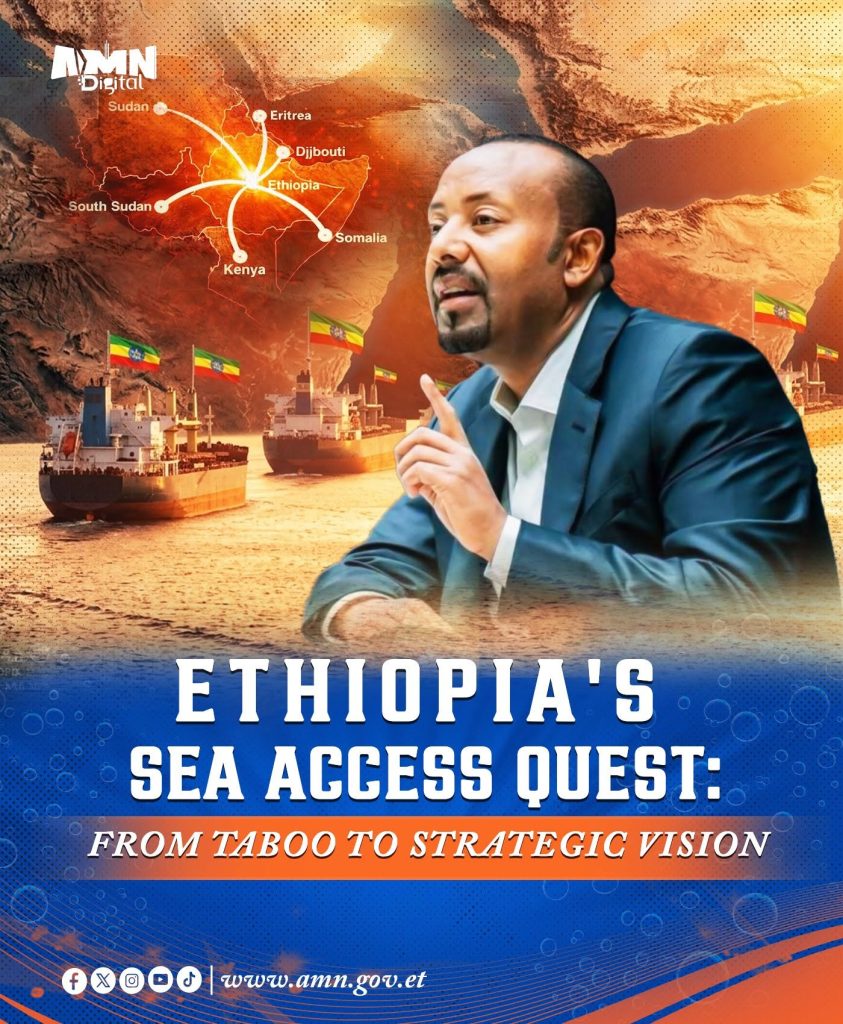
Ethiopia is a great nation built upon one of the world’s oldest civilizations, a country rich in history, dignity, and honor. Yet denying this vast nation of millions access to the sea is akin to cutting off its wings and depriving it of the very means through which it breathes.
Today, the issue of sea access has risen above all other development, political, and diplomatic agendas to become Ethiopia’s foremost national priority and a guarantee of its survival. It represents a red line that safeguards intergenerational continuity, sovereignty, and economic independence.
For several decades, the issue of sea access remained a hidden agenda within Ethiopia’s political discourse. Merely raising the subject was often discouraged. Previous administrations treated this significant national aspiration as a taboo, preventing it from being openly discussed.
Ethiopia’s claim and aspiration regarding sea access were suppressed, while the public was subjected to psychological pressure and led to believe that no viable alternative existed. It was an era in which generations silently endured the burdens of landlocked status, yet lacked the confidence to voice their concerns.
Speaking about sea access was frequently portrayed as an act of warmongering, a diplomatic misstep, or even a political offense. It was a period during which the nation’s breathing space was effectively constrained, a memory that remains fresh in the collective consciousness of many Ethiopians.
Truth, however, does not remain buried forever.
Since the advent of the reform era, the new administration and the generation inspired by the philosophy of Medemer have broken through this longstanding psychological barrier and climate of fear.
The issue of sea access has been brought into the public arena, not as a political gamble or a distant dream, but as a matter fundamental to the daily lives and very existence of the Ethiopian people. It has been advanced with courage, conviction, and strategic vision.
This generation has begun writing a new chapter by asking a simple yet profound question: Why? It seeks to uphold what many Ethiopians regard as the country’s historical and natural rights. Since the reform period, the government has consistently emphasized this agenda through diplomatic, economic, and social platforms, elevating it to the center of national attention.
The silence has been broken, and the restrictions have collapsed. Today, the issue of sea access has become a focal point of national discussion, from households to public squares, and from policymakers to the broader public.
The younger generation has embraced this historic call wholeheartedly. For years, many Ethiopians quietly asked themselves, “Why have we become a landlocked nation?” Today, that same public raises the issue with renewed conviction and determination.
This movement is no longer solely a government initiative; it has become the shared heartbeat of Ethiopians across the country and throughout the diaspora. The message echoed from every corner of the nation conveys unwavering commitment: Ethiopia seeks to secure sea access through peaceful means, legality, dialogue, and the principle of mutual benefit. For many citizens, this principle has become a deeply held conviction.
This public awakening has strengthened the country’s negotiating capacity and diplomatic leverage. Understanding the significance of sea access, this generation has embraced a renewed sense of national purpose, viewing it as essential to future prosperity and to securing a brighter future for generations yet to come.
The agenda of sea access has become, for many Ethiopians, an irreversible pillar of national survival and sovereignty. What was once feared and concealed has, through the reform process and the resilience of the people, become a beacon of hope for the nation’s future.
Many believe that without secure and sustainable access to the sea, Ethiopia risks remaining trapped in cycles of poverty and dependency. Strengthening this emerging national movement through knowledge, psychological preparedness, and unity is therefore viewed as a historic responsibility shared by all Ethiopians.
By fulfilling this responsibility, Ethiopians can repay their debt to history and work toward ensuring that future generations inherit a prosperous and dignified nation with secure and reliable access to maritime trade.
Ethiopia’s gateway to the sea is seen not merely as an economic necessity, but as a guarantee of prosperity, a doorway to greater independence, and a symbol of national dignity.
By Birhanu Workneh