AMN Plus-August 13, 2026
Ethiopia and Russia have maintained longstanding diplomatic relations spanning more than a century. In recent years, the relationship has gained renewed momentum, evolving into a broader strategic partnership focused on trade and investment, agriculture, energy, science and technology, peace and security, and diplomacy.
Since the establishment of diplomatic relations, the two countries have worked to expand cooperation across a wide range of sectors. Ethiopia’s accession to BRICS has added a new dimension to bilateral ties, creating further opportunities for the two countries to coordinate their positions and leverage their respective strengths on global issues.
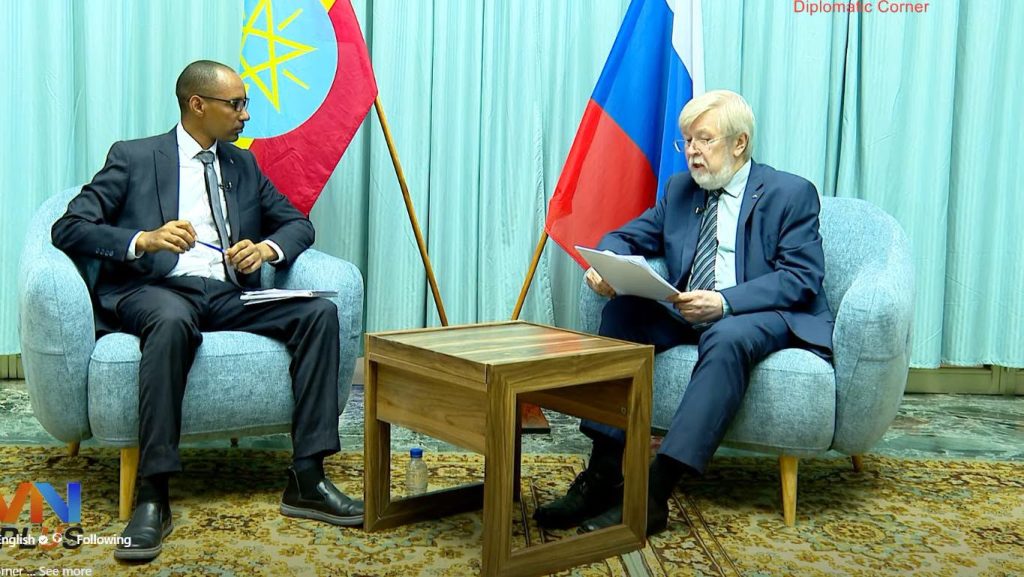
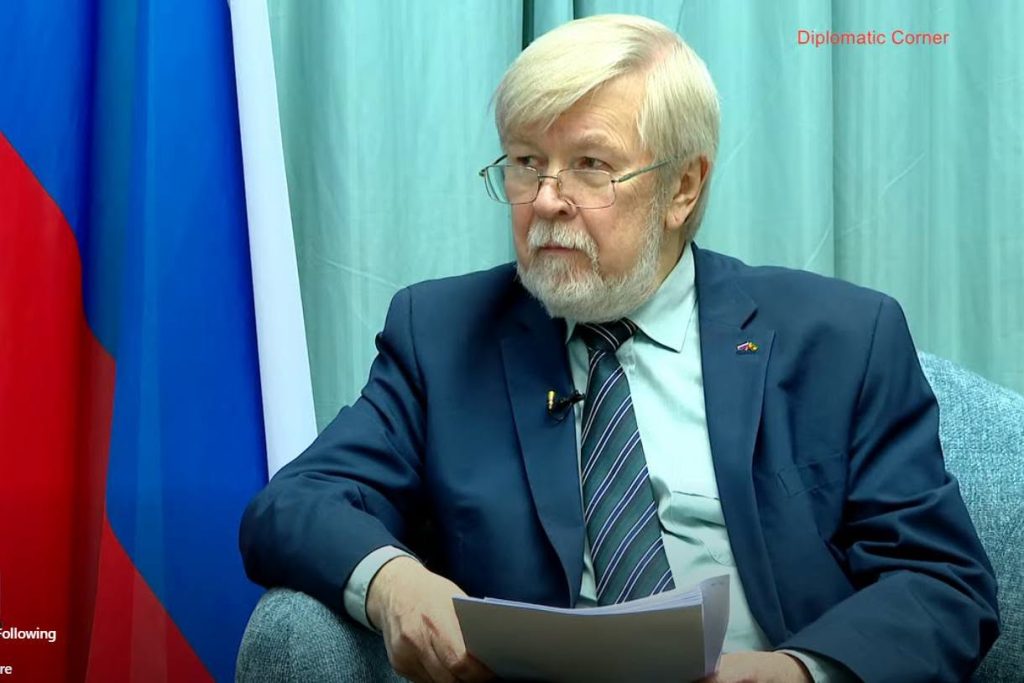
Speaking exclusively to Addis Media Network’s Diplomatic Corner, Russian Ambassador to Ethiopia Evgeny Terekhin discussed Russian Foreign Minister Sergei Lavrov’s recent visit to Addis Ababa. The ambassador said Lavrov’s visit was part of a broader tour of several African countries. During his stay in Ethiopia, the Russian foreign minister held talks with Prime Minister Abiy Ahmed (PhD) and Foreign Minister Gedion Timothewos (PhD).
Explaining the significance of the visit, Ambassador Terekhin recalled the widely used description of Addis Ababa as a “gateway to Africa,” noting that Lavrov chose the Ethiopian capital as his first destination on the African leg of his tour.
According to the ambassador, the primary objective of Lavrov’s visit was to synchronize the two countries’ priorities across a broad spectrum of bilateral cooperation. Substantive discussions with Prime Minister Abiy Ahmed and Foreign Minister Gedion Timothewos focused particularly on the practical implementation of previously concluded bilateral agreements.
The two sides reaffirmed their commitment to building cooperation on the foundation of mutually beneficial national interests and developing a shared vision of a renewed and more equitable multipolar world order.
The discussions also addressed the promotion and coordination of joint initiatives in multilateral forums, trade and investment, healthcare, epidemic preparedness and response, science, education, and humanitarian affairs. Particular emphasis was placed on advanced technologies and large-scale infrastructure projects.
The ambassador said these efforts are also intended to strengthen Addis Ababa’s role in Russia’s broader engagement with Africa ahead of the Third Russia-Africa Summit, scheduled to take place in Moscow on October 28–29, 2026.
Another important aspect of Lavrov’s visit was his meeting with African Union Commission Chairperson Mahmoud Ali Youssef. Ambassador Terekhin said the two sides reached a principled agreement to establish a regular framework for cooperation, including annual high-level consultations and sectoral dialogues involving relevant Russian agencies and departments of the African Union Commission. He added that the parties adopted a detailed joint statement outlining common approaches to building a new, more polycentric international order.
Speaking about Ethiopia’s role in the region, Ambassador Terekhin described the country as an anchor of stability and a pivotal state for peace and security in the Horn of Africa. He said Ethiopia’s longstanding commitment to pursuing an independent and sovereign foreign policy, while firmly defending its national interests, aligns closely with Russia’s vision of a multipolar international system free from external dictates.
Beyond its role as Africa’s diplomatic capital, the ambassador highlighted Ethiopia’s demographic and economic potential, saying the country’s rapid economic transformation is creating new opportunities for Russian investment in key sectors. He also noted that Ethiopia’s full membership in BRICS further strengthens the strategic alignment between the two countries and creates additional opportunities for cooperation on the global stage.
In this context, Ambassador Terekhin emphasized the relevance of the concept of “MEDEMER,” which he said has gained recognition in global political discourse. He stressed that the Russian-Ethiopian partnership goes beyond narrow transactional interests, with Russia seeking to establish sustainable cooperation frameworks aimed at promoting the prosperity of both peoples and supporting long-term economic growth without external neocolonial pressure.
By Birhanu Workneh