
AMN PLUS-May 31, 2026
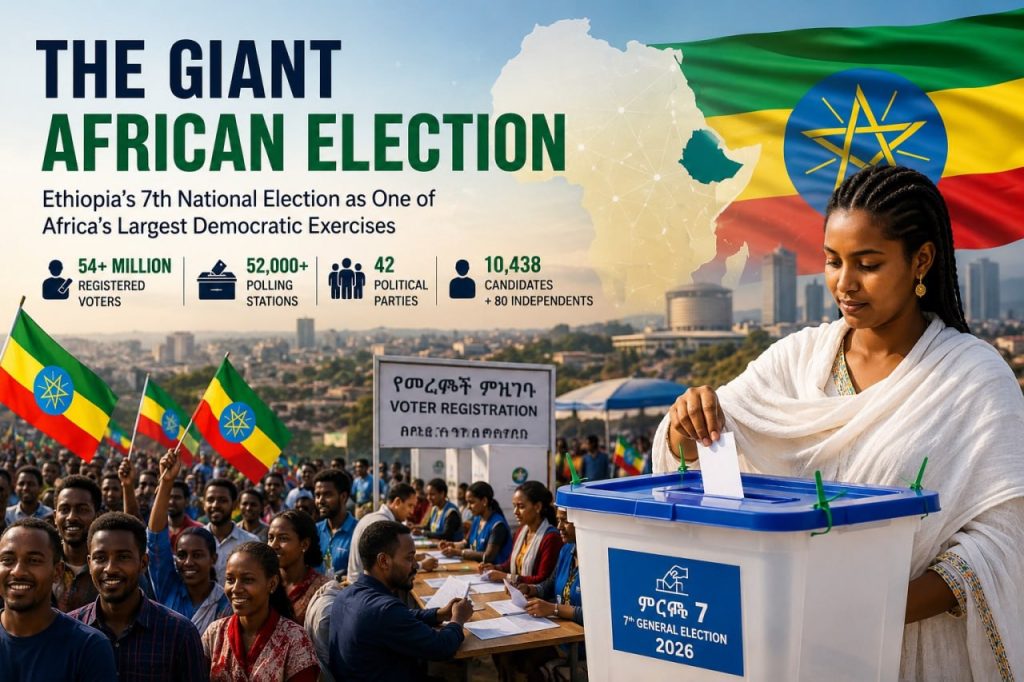
On Monday, Ethiopia will undertake one of the largest democratic exercises not only in Africa, but in the developing world. The country’s 7th General Election is more than a constitutional process; it is a political event with continental-impact: 54+ million voters registered to cast their ballots at 52,000 polling stations across the country, 42 political parties that field 10,438 candidates in addition to 80 independent ones. The enormity of logistical coordination is therefore evident towards the successful conduct of Africa’s largest electoral event.
And few countries on the continent possess the demographic scale, political complexity, institutional reach, and organizational capacity required to conduct such an undertaking.
A Democracy of Continental Scale
Ethiopia today has a population exceeding 130 million people, making it the second most populous country in Africa. Of this number, more than 54 million citizens have registered to vote in the upcoming election, according to the National Electoral Board of Ethiopia.
That figure alone makes Ethiopia’s election historically significant.
To understand the magnitude, one must compare it globally and continentally.
The number of voters registered to cast ballots in the 7th Ethiopian Parliamentary and Regional Councils elections is comparable to the entire population of Kenya, and roughly equivalent to the combined populations of several mid-sized African nations. It is also comparable to the voting populations of some of the long-established democracies having hundreds of millions of citizens.
In many advanced democracies, voter registration itself remains a major challenge. Even countries with centuries-old democratic traditions struggle with voter participation, declining civic engagement, and low registration rates among youth populations.
Ethiopia’s ability to mobilize and register well more than 54 million citizens under conditions of a vast geographical area, infrastructural limitations, linguistic diversity, and socioeconomic complexity — it is therefore a remarkable institutional achievement.
The Meaning Behind the Numbers
If Ethiopia’s population is estimated at over 120 million, then a voting-age population of around 60–65 million citizens would be expected. The performance to register 54+ million voters therefore represents an exceptionally high level of electoral enrollment.
This demonstrates several important realities: expanding public awareness of electoral participation, increasing institutional penetration into local communities, rising civic consciousness, and strong national engagement with democratic processes.
In many countries, especially within the developing world, large segments of eligible citizens remain outside electoral systems due to administrative weaknesses, political distrust, migration, conflict, or logistical barriers.
Yet Ethiopia has managed to bring tens of millions into the formal democratic process.
That achievement deserves recognition.
A Logistical Operation of Extraordinary Magnitude
Conducting an election of this scale posed the most difficult logistical operations —managing such a large-scale voting event demands an exceptionally complex coordination of resources, transport, and personnel.
The Ethiopian election involves: thousands of polling stations, massive ballot distribution systems, nationwide security coordination, transportation networks extending into remote rural areas, multilingual electoral materials, training of large numbers of election officials, coordination with observers, media access, vote-counting procedures, and the management of millions of individual ballots.
Few countries possess the institutional machinery required to coordinate such a process nationwide. The logistical complexity becomes even greater when one considers Ethiopia’s geographical realities: mountainous terrain, vast rural populations, infrastructure gaps, linguistic diversity, and significant regional variation.
Yet despite these challenges, the country has managed to organize one of the continent’s largest elections.
All that required a top-grade efficiency, and the state of Ethiopia proved capable in doing that towards the successful conduct of Africa’s major democratic exercise.
Forty-Two Political Parties and Democratic Pluralism
One of the most striking features of the election is the participation of approximately 45 political parties.
This is not a small detail.
Managing an election involving dozens of political organizations dramatically increases the complexity of electoral administration. Each party requires: legal registration, ballot access, candidate verification, campaign coordination, observer representation, media management, dispute resolution mechanisms, and logistical accommodation within the electoral framework.
In many countries, even organizing elections with a handful of parties creates administrative strain. Ethiopia is attempting this process with dozens of competing political actors representing different ideologies, regions, interests, and constituencies.
This reflects not only political diversity, but also the expansion of civic and political space.
The presence of multiple political parties demonstrates that Ethiopia’s democratic conversation is broad, contested, and dynamic. Democracy is not defined by uniformity; it is defined by participation, debate, competition, and institutional processes capable of accommodating difference.
The Ethiopian election therefore reflects both democratic scale and democratic pluralism.
A Nationwide Democratic Infrastructure
Another extraordinary aspect of the election is the nationwide infrastructure required to host millions of voters simultaneously.
Thousands of polling stations across urban and rural Ethiopia must: receive electoral materials, process voters, verify registration, ensure ballot security, and transmit results within legal frameworks.
This requires an enormous administrative ecosystem involving sufficient numbers of well-trained: election workers, security personnel, transport systems, communication networks, legal institutions, local administrators, and media organizations.
The ability to organize such a nationwide electoral infrastructure in one of Africa’s largest and most diverse countries is itself evidence of state capacity and democratic institutionalization.
Ethiopia and the African Democratic Story
The significance of Ethiopia’s election extends beyond national borders because Ethiopia occupies a unique position within Africa.
As the diplomatic capital of Africa and the headquarters of the African Union, Ethiopia has historically played a central role in shaping continental political identity. The country has long symbolized African independence, sovereignty, and Pan-African cooperation.
Today, Ethiopia’s democratic evolution forms part of a larger African democratic story.
Across the continent, African societies continue to strengthen institutions, expand civic participation, and deepen constitutional governance despite ongoing challenges. Ethiopia’s election contributes to this continental democratic momentum.
At a time when global narratives often focus disproportionately on African instability, Ethiopia’s election offers a different image: millions participating peacefully, multiple parties competing politically, institutions managing nationwide civic engagement, and democratic participation occurring on a massive scale
This is an African success story that deserves international attention.
A Great Country Conducting a Great Election
Ultimately, the 7th Ethiopian General Election represents more than a periodic vote.
It is one of Africa’s largest electoral exercises, one of the continent’s most logistically demanding democratic undertakings, one of the developing world’s biggest voter mobilizations, and one of the strongest contemporary examples of African democratic participation at scale.
Large countries inevitably produce large political processes.
And Ethiopia — with its immense population, historical significance, political diversity, and continental role — is conducting a correspondingly giant election.
This is why the upcoming vote deserves to be understood not merely as an Ethiopian political event, but as one of Africa’s defining democratic moments.
Because when a country of more than 130 million people organizes a nationwide election involving 54 million voters, 42 political parties, thousands of polling stations, and millions of ballots, the continent itself takes notice. This is not simply an election in Africa.
It is one of Africa’s great elections, according to Pulse of Africa.