
AMN Plus-August 18, 2026
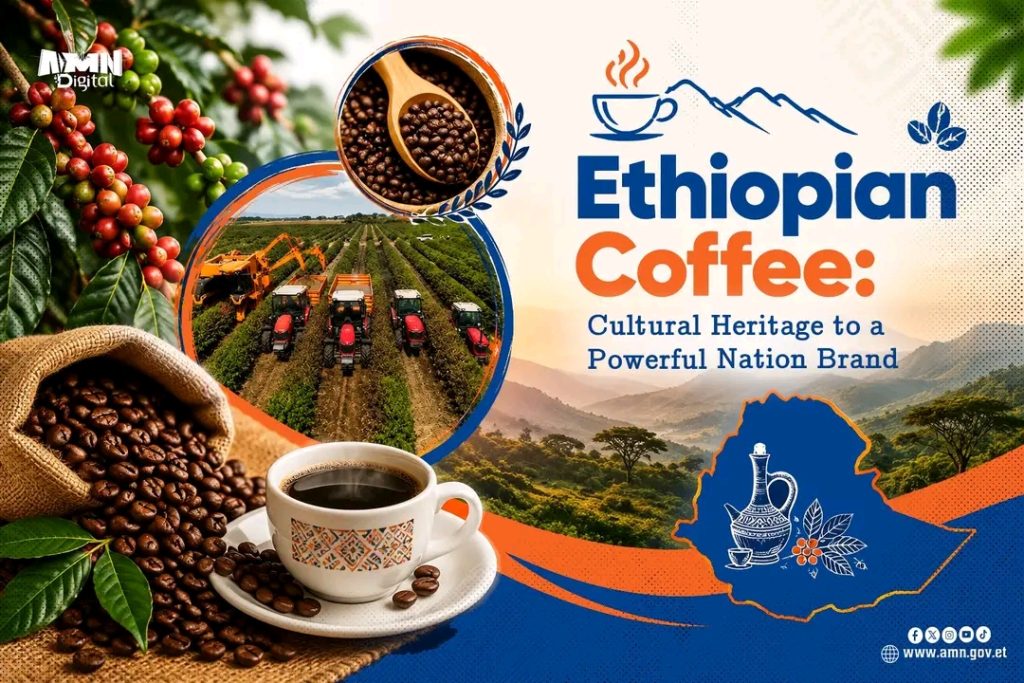
Among the many gifts Ethiopia has shared with the world, coffee holds a truly special place. More than a crop, a beverage, or an export commodity, coffee is part of the country’s identity.
It is woven into Ethiopia’s history, culture, social life, agriculture, and economy, and increasingly, it is becoming a powerful way for the country to tell its story to the world.
Widely recognized as the birthplace of Arabica coffee, Ethiopia possesses a coffee heritage unlike any other.
Its diverse landscapes, indigenous coffee varieties, generations of farming knowledge, and distinctive coffee traditions have given the country a unique position in the global coffee industry.
For Ethiopians, however, coffee means much more than its international reputation suggests.
It is at the heart of social life and a symbol of hospitality, friendship, respect, and togetherness.
The traditional Ethiopian coffee ceremony, passed from one generation to the next, remains one of the clearest expressions of this cultural heritage.
In many Ethiopian homes, coffee is prepared once or even several times a day. Family members, neighbors, and friends gather around the coffee table to share stories, discuss their daily lives, exchange advice, celebrate important moments, and sometimes resolve disagreements.
The ceremony creates a space for conversation, reconciliation, and human connection.
Across Ethiopia, cafes and coffeehouses have become important meeting places where students, professionals, businesspeople, academics, elders, and young people come together.
Over a cup of coffee, conversations can range from family and friendship to business, culture, sports, politics, and national affairs.Coffee is also one of Ethiopia’s most enduring expressions of hospitality. Offering coffee to a guest is not merely an invitation to drink. It is an invitation to sit down, talk, connect, and share a moment together. Behind the simple words, “Please have some coffee,” lies a deeper message of welcome, respect, friendship, and generosity.
At the same time, coffee is an increasingly important pillar of Ethiopia’s economy.
According to the Ethiopian Coffee and Tea Authority, the country’s coffee export earnings exceeded $3 billion in the 2025/26 fiscal year, marking a historic milestone for the sector.
This record performance demonstrates the growing importance of coffee to Ethiopia’s foreign-exchange earnings and broader economic development.
It also highlights the country’s increasing ability to transform one of its most celebrated agricultural products into a stronger source of economic opportunity.
Ethiopian coffee is already recognized around the world through distinctive origins.
Ethiopia’s unique coffee flavors, distinctive growing conditions, and time-honored production traditions have established the country as one of the world’s most prestigious and sought-after coffee origins. But the opportunity goes beyond simply exporting more coffee.
Ethiopia can increasingly use coffee as a vehicle for nation branding, presenting coffee not merely as a product, but as a story of origin, authenticity, culture, quality, hospitality, biodiversity, and innovation. Every cup of Ethiopian coffee can tell a story.
It can tell the story of farmers who have cultivated coffee for generations; of highlands and forests where coffee grows in remarkable environments; of indigenous knowledge passed from parents to children; of communities whose livelihoods are connected to coffee; and of a culture in which sharing coffee means sharing time, conversation, and friendship.
This gives Ethiopian coffee an extraordinary advantage in the global marketplace.
The country is also placing greater emphasis on quality improvement, traceability, value addition, agro-processing, specialty coffee, and access to premium international markets.
These efforts can help Ethiopia move beyond the traditional model of exporting largely raw coffee beans and capture a greater share of the value through roasting, packaging, branding, and finished coffee products.
Such a transformation would allow Ethiopia to earn more from coffee while strengthening the identity of Ethiopian coffee in international markets.
More importantly, it can strengthen Ethiopia’s image beyond the coffee industry itself.
Coffee can become a cultural ambassador, an instrument of economic diplomacy, a bridge for cultural exchange, a tool for tourism promotion, and a platform for nation branding. International visitors who encounter Ethiopian coffee are not simply experiencing a beverage; they are encountering a tradition, a people, and a way of life.
The connection between coffee and tourism is particularly powerful.
A visitor who experiences a traditional coffee ceremony, visits a coffee-growing community, walks through coffee forests, learns about local production, and tastes specialty coffee experiences Ethiopia through all five senses.
Coffee can therefore help transform Ethiopia’s coffee heritage into a broader tourism experience.
From smallholder farms to international cafes, coffee connects Ethiopia’s rural communities with global consumers. From the traditional jebena to modern specialty coffee shops, it connects the past with the present. And from the intimate conversations around a family coffee table to the billions of dollars generated through exports, it connects social life with national development.
Ethiopia’s coffee brand should stand for more than origin. It should communicate authenticity, excellence, heritage, hospitality, sustainability, creativity, and innovation. Strong branding, quality assurance, intellectual-property protection, compelling storytelling, and sustained international marketing can help ensure that Ethiopian coffee commands not only recognition but also greater value in global markets.
The ultimate ambition should not simply be for the world to recognize Ethiopia as a country that produces coffee. It should be for people around the world to associate Ethiopia with the home of coffee, authentic coffee culture, exceptional quality, warm hospitality, and a rich living heritage.
The continued success of Ethiopian coffee is therefore much more than an export achievement.
It is an opportunity to transform one of Ethiopia’s most beloved traditions into a powerful instrument of economic diplomacy, cultural diplomacy, tourism promotion, and nation branding.
Ethiopian coffee tells a story that begins in the soil and reaches far beyond the cup. It is a story of farmers and families, forests and landscapes, tradition and innovation, commerce and culture, friendship and hospitality. And perhaps that is the greatest strength of Ethiopia’s coffee story: every cup carries a piece of Ethiopia to the world.
By Birhanu Workneh